Permitting Watch · Feature
Kamloops Mines Branch Issued 3 New Placer NOWs in 2026
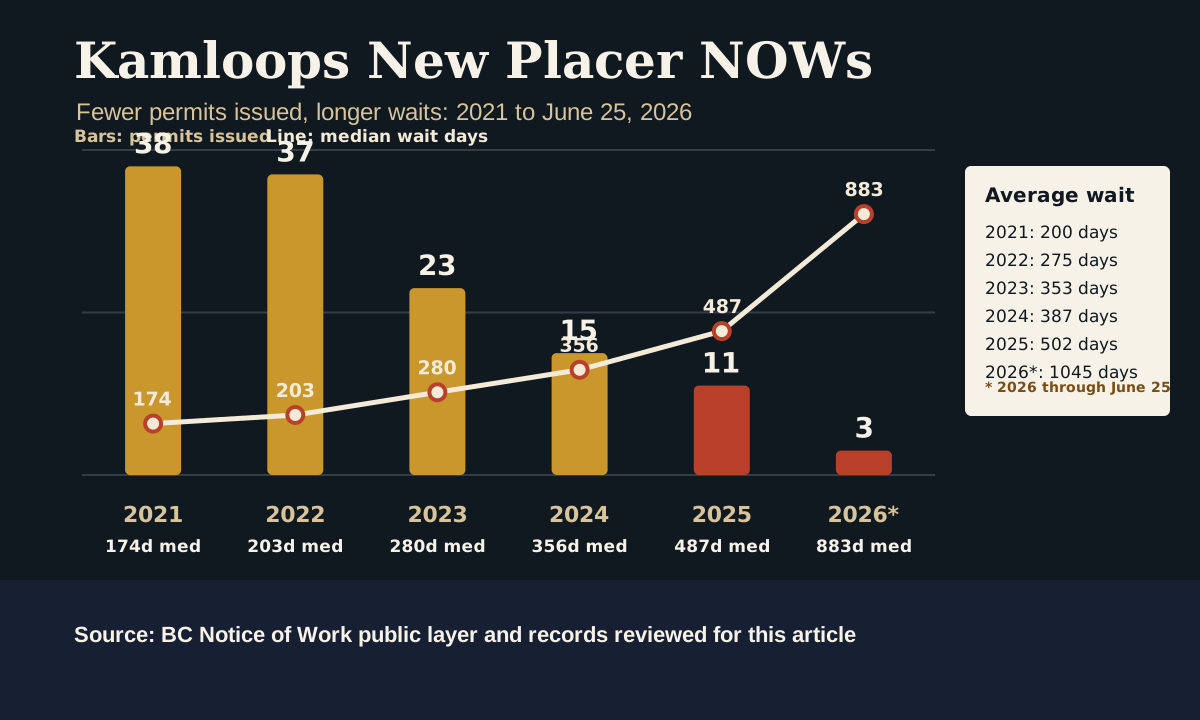
The issue-year record is worse than a simple backlog story: permits issued have fallen from 38 in 2021 to 3 through June 25, while the median wait rose from 174 days to 883 days.
KAMLOOPS, BC: The Kamloops placer record is not simply a story about one bad year. It is a five-year collapse in new placer Notice of Work issuance, paired with a sharp rise in how long miners wait before a permit is issued.
For new placer NOWs issued by the Kamloops Mines Branch, the trend is striking. The branch issued 38 in 2021, 37 in 2022, 23 in 2023, 15 in 2024, 11 in 2025 and only 3 through June 25, 2026.
The wait times moved in the opposite direction. Median wait rose from 174 days in 2021 to 203 days in 2022, 280 days in 2023, 356 days in 2024, 487 days in 2025 and 883 days for the three permits issued through June 25, 2026.
Average wait followed the same pattern: 200 days in 2021, 275 in 2022, 353 in 2023, 387 in 2024, 502 in 2025 and 1,045 days for the 2026 permits issued through June 25.
The 2025 and 2026 issue years show how severe the slowdown has become. Kamloops issued 11 new placer NOWs in 2025 after a 487-day median wait. Through June 25, 2026, it issued 3 after an 883-day median wait. By that point, the few files reaching approval were taking multiple seasons to clear.
The Kamloops Mines Branch is not a small corner desk. It covers South Central BC, including the Okanagan and the Cariboo, with active mining areas around Likely, Barkerville and other rural communities where placer work remains part of the local economy.
At the time of writing, 91 placer permit applications from the Kamloops office were delayed, waiting or otherwise unresolved. Province-wide, the outstanding Notice of Work count stood at 154 placer operations, 168 mineral applications and 322 total outstanding mineral and placer NOWs.
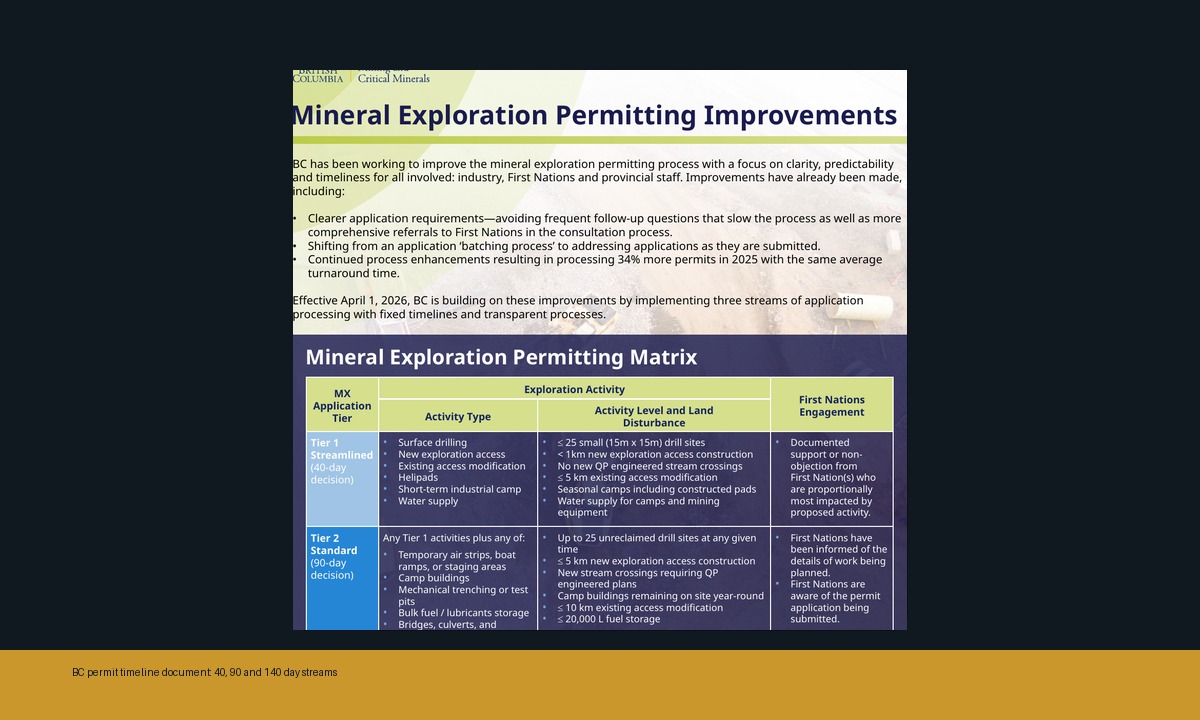
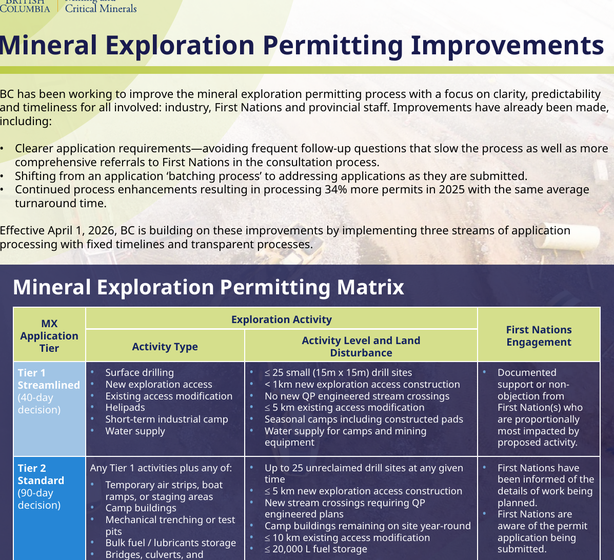
The Province of British Columbia is telling miners that exploration permitting is becoming clearer, faster and more predictable. The Ministry of Mining and Critical Minerals points to fixed decision streams, including a 140 day stream for complex files, and escalation when timelines are missed.
The Kamloops issue-year record does not support that message. A branch that once issued nearly 40 new placer NOWs a year is now issuing only a handful, and the few that do get issued are taking far longer than the public benchmark operators are told to expect.
The three new placer NOWs issued through June 25, 2026 were not quick files. Their waits were 865 days, 883 days and 1,387 days. The median was 883 days. The average was 1,045 days.
For family placer businesses in the Cariboo, that is not an abstract administrative lag. A file waiting 883 days can erase multiple work seasons. A file waiting 1,387 days can outlast the original plan, the equipment arrangement, the financing and the crew.
One Cariboo-region family placer application in the reviewed record had been waiting more than 1,100 days. Another had been waiting more than 1,080 days. These are not distant paperwork entries. They represent small operators that cannot get onto the ground, hire crews, book equipment or create local work while files remain unresolved.
The work is seasonal and local. A new placer mine can support excavator operators, dozer operators, mechanics, welders, truck drivers, fuel suppliers, surveyors, consultants, camp providers, grocery stores, equipment dealers and seasonal workers. A small mine may look minor from Victoria, but in a rural economy it can matter.
Staffing pressure may be real. Regional offices need experienced people, technical capacity and enough staff to manage referrals, consultation, inspections and decisions. But staffing is no longer an adequate explanation for the Kamloops pattern.
Staffing does not explain why issued new placer NOWs fell from 38 in 2021 to 3 through June 25, 2026. Staffing does not explain why median waits climbed from 174 days to 883 days. Staffing does not explain why files can remain in referred, received, referral complete, government action required or client delayed status for extraordinary periods without a clear public explanation.
At some point, staffing shortages alone no longer appear sufficient to explain the pattern. The harder explanation is policy: internal choices, risk settings, consultation practices, regional priorities and management decisions that determine whether a file moves or disappears into the machine.

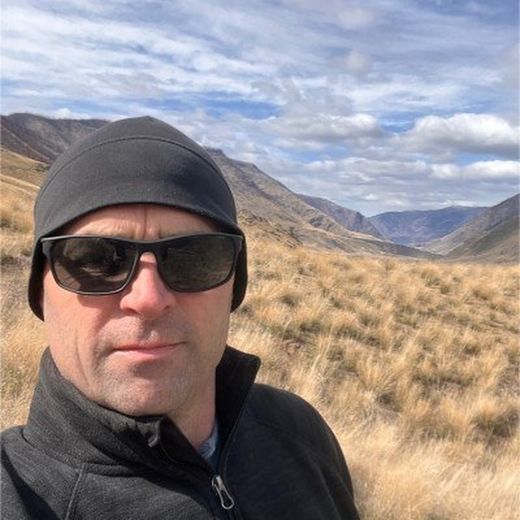
Nini Long is Executive Director of Regional Operations. Mike Cloet is Acting Regional Director South Central for the Kamloops regional office. Those roles place them in the regional management chain responsible for permitting delivery in South Central BC.
When asked about delayed permits, Mike Cloet described permits as stuck in “virtual space.” That phrase lands because it sounds exactly like what miners are experiencing: applications that are neither approved nor refused, neither alive nor dead, suspended somewhere inside a process that produces no practical decision.
But “virtual space” is not a statutory decision. It is not a permit condition. It is not a transparent reason. It is not an answer a small mining business can take to a lender, a mechanic, a fuel supplier or a crew waiting for the season to start.
The questions for Cloet and Long are direct. Why has the Kamloops Mines Branch fallen from 38 issued new placer NOWs in 2021 to 3 through June 25, 2026? Why has the median wait for issued permits climbed to 883 days? How many Kamloops placer applications have been escalated under the government’s own timeline policy? What happened after escalation?
Industry does not need another glossy process chart. It needs decisions. A timeline is meaningful only if files are actually decided within something close to that timeline. An escalation process is meaningful only if applicants can see that it works. Transparency is meaningful only if the Ministry explains why files are stuck and who is accountable for moving them.
Responsible placer miners are not asking government to ignore environmental standards. They are not asking government to bypass First Nations consultation. They are not asking for automatic approvals. They are asking for a functioning process that produces timely, transparent and defensible decisions.
A responsible permitting system should be able to say yes, no, or yes with conditions. It should protect water, fish habitat, cultural heritage, public safety and reclamation outcomes. It should also recognize that small mining businesses cannot survive indefinite delay.
The bottom line is simple. Kamloops issued fewer new placer NOWs in 2025 than in the previous four years, and those approvals came after much longer waits. Through June 25, 2026, it had issued only 3, with an 883-day median wait and a 1,045-day average wait.
For miners, this is not politics in the abstract. It is whether BC still has a working path for responsible small-scale mining. For rural communities, it is jobs, contractors, suppliers and seasonal income. For the Province, it is a credibility test.
If the government sells predictable permitting while the Kamloops Mines Branch issues only 3 new placer NOWs in half a year and those files have a median wait of 883 days, the messaging does not match the numbers on the ground.
Source Notes
- BC Ministry of Mining and Critical Minerals, Mineral Exploration Permitting Improvements PDFProvincial document describing mineral exploration permitting streams and fixed timelines.
- BC government news release on 40 to 140 day exploration permit timelinesProvince states that beginning April 1, 2026, exploration permits will be processed within 40 to 140 days depending on complexity.
- BC Government Directory, Regional OperationsRole reference for Nini Long, Executive Director of Regional Operations.
- BC Government Directory, Regional Operations KamloopsRole reference for Mike Cloet, A/Regional Director South Central for the Kamloops regional office.
- BC Notice of Work placer operations data reviewed by BC Mine LedgerPermit records and status analysis current to June 25, 2026, including Kamloops issue-year counts, wait times and province-wide outstanding NOW counts.
- BC Notice of Work Spatial Locations - PublicPublic BC dataset used to verify Notice of Work application type, submitted date, issue date, status and regional office fields.