Policy and Regulation · Issue Brief
The Consultation Double Standard: BC's Mining Bans Hit First, Ask Questions Never
British Columbia demands extensive consultation for routine permits while implementing major staking prohibitions through surprise announcements with zero consultation for affected parties.

British Columbia's approach to mineral tenure has created a troubling precedent: sudden prohibitions on new claims with zero consultation for affected tenure holders, while demanding extensive consultation for everything else. Recent staking bans in Tahltan and Ktunaxa territories expose the glaring inconsistency in how 'consultation' gets applied.
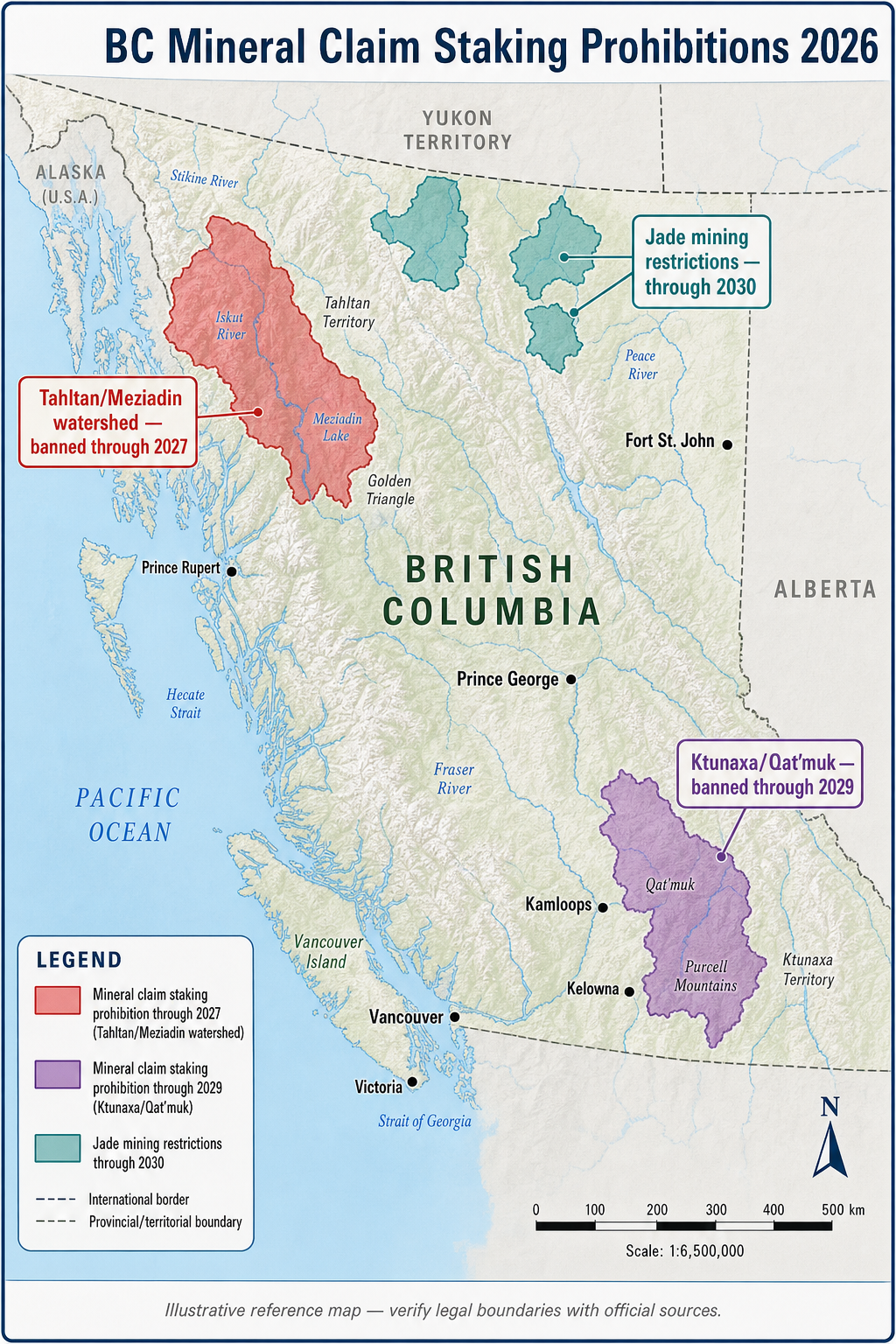
Two major staking prohibitions now lock out prospectors and mineral explorers across significant portions of BC. A mineral claim registration pause through January 31, 2027 covers thousands of hectares in northwestern BC's Golden Triangle, halting new mineral and placer claims while the province completes 'land-use planning' with Tahltan, Taku River Tlingit, and Kaska First Nations.
An even longer prohibition runs until March 31, 2029 in the Central Purcell Mountains. The three-year pause covers 70,000 hectares of what was formerly the controversial Jumbo Glacier Resort site. Both bans share the same blueprint: immediate prohibition, indefinite timelines, and no advance warning to affected claim holders.
These recent bans follow the pattern established with jade mining restrictions in May 2020. An Order in Council imposed a sudden two-year moratorium on new jade placer permits in Tahltan territory, later extended to a complete prohibition on new jade citations through April 2030.
Jade operators with existing tenure discovered the ban through government press releases, not consultation meetings. The moratorium effectively ended jade exploration in northwest BC while existing operators face a five-year wind-down period.
The irony runs deeper than simple timing. BC's regulatory framework demands extensive consultation for routine permitting decisions: Notice of Work applications now include mandatory First Nations engagement before approval; water authorizations require consultation that can delay seasonal operations for months; environmental assessments feature multi-year consultation phases.
The Mineral Claims Consultation Framework launched in 2025 requires 30-day First Nations response windows for every new claim application. Yet when government wants to remove access entirely, consultation becomes optional.
This pattern sends a clear message to mineral explorers: your investment in claims research, geological assessment, and community relationships can be canceled overnight through executive order. No hearing. No transition period. No compensation discussion.
Consider what a placer miner learns from these precedents. Research means nothing - you can spend months studying geological surveys, old workings, and land status, only to have access removed by surprise announcement. Existing rights offer limited protection, as the jade precedent shows eventual phase-out pressure.
Consultation rhetoric is selective - government demands it from industry but exempts itself from the same standard. Permit backlogs create exposure, as the longer your Notice of Work sits in a ministry queue, the more political risk you face from shifting land-use policies.
These bans don't just affect large mining companies. They hit small-scale placer operators who rely on seasonal access to traditional goldfields, prospectors and claim stakers who depend on new ground for their livelihood, local contractors in communities like Dease Lake, Stewart, and Cassiar, and Indigenous-owned businesses that service exploration and mining activity.
Northern BC communities understand that mineral exploration creates jobs, generates revenue for local suppliers, and funds infrastructure improvements. But consultation about economic impact never happens before the ban announcements.
Jade mining companies have challenged the government's approach through BC Supreme Court, arguing the prohibitions amount to expropriation without compensation. Their civil claim highlights the pattern: sudden executive orders that eliminate business opportunities without due process or meaningful consultation.
The legal challenge argues that the bans 'prevented them from conducting their mining activities or acquiring the permits required to work on their existing tenures.' This describes the immediate impact of policy-by-announcement.
Nobody questions that First Nations deserve meaningful consultation on land use in their traditional territories. The UN Declaration on the Rights of Indigenous Peoples, adopted by BC in 2019, establishes clear standards for engagement and consent.
But when First Nations demand consultation, they get it. When tenure holders face sudden loss of access, they get press releases. This creates a concerning asymmetry: one group's consultation rights matter enough to halt all activity, while another group's consultation rights don't exist at all.
Genuine consultation-based policy would include advance warning - affected parties learn about potential restrictions before they're implemented, not through news coverage. Transition planning would give existing operations reasonable timelines to adjust business plans and complete committed work.
Impact assessment would consider economic effects on local communities, small operators, and Indigenous businesses that benefit from mineral activity. Compensation frameworks would provide recourse beyond expensive lawsuits when existing rights lose value through policy changes.
Defined timelines would ensure land-use planning processes operate within clear deadlines instead of indefinite suspension periods.
BC talks a good game about critical minerals, electrification supply chains, and resource sector development. Premier Eby regularly emphasizes the importance of mining to the provincial economy. But speech-making doesn't create mines. Land access does.
Every moratorium, every indefinite 'pause,' and every surprise prohibition makes BC less attractive to mineral investment. Capital markets notice when governments prioritize process over results.
The consultation double standard undermines both reconciliation and resource development. Meaningful engagement requires good faith from all parties. Sudden prohibitions without discussion demonstrate bad faith from government.
BC's approach to mineral tenure consultation should apply the same standards to everyone: advance engagement before major policy changes affect existing users, defined timelines for land-use planning processes, impact consideration that includes economic effects on affected communities, and transition support when access restrictions become necessary.
First Nations deserve consultation. So do tenure holders, local communities, and small operators whose livelihoods depend on mineral access. True reconciliation means building relationships based on mutual respect and shared economic opportunity. It doesn't mean some consultation matters while other consultation gets canceled by press release.
Source Notes
- BC Mineral Titles News and AnnouncementsOfficial government announcements of staking pauses and moratoriums.
- Tahltan Nation Statement on Jade Moratorium, May 2024Tahltan Central Government statement supporting the province's jade mining restrictions.
- BC Supreme Court - Cassiar Jade Contracting Inc. v British Columbia, 2025 BCSC 1566Legal challenge to jade mining restrictions arguing expropriation without compensation.